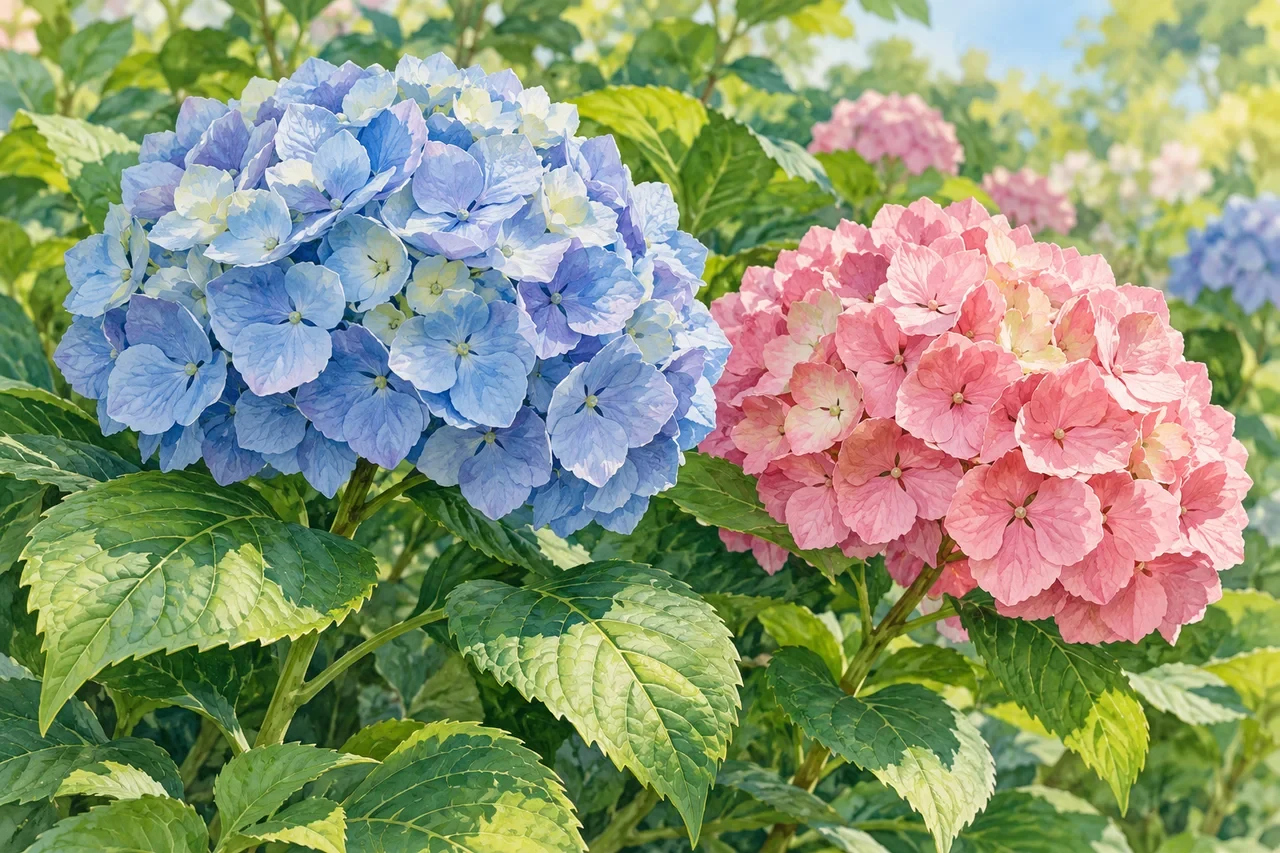
Illustrative editorial image generated with AI.
Blue or pink hydrangea flowers are not simply the result of how often you water. In varieties capable of changing colour, soil pH affects access to aluminium. Not every hydrangea responds alike, so identify the species and cultivar before attempting a change.
How does soil pH affect colour?
The Royal Horticultural Society’s hydrangea guide explains that some Hydrangea macrophylla and Hydrangea serrata cultivars can produce blue flowers in acidic conditions with greater aluminium availability, and pink flowers in more alkaline conditions. Intermediate purple shades can also occur. Adding something to the soil will not turn every hydrangea blue.
Find the cultivar label first
If you still have the plant label, record the species and cultivar name. Before selecting a product from a flower photograph alone, ask the grower or nursery whether that cultivar can shift between pink and blue. Do not expect the same response from a white-flowered hydrangea.
Ageing flowers are a different comparison
Flower heads can change colour as they age, a seasonal process also described by the RHS. Comparing a fresh bloom with one that has been on the plant for weeks does not, by itself, show that a soil treatment worked. Record whether flowers are newly opened or older whenever you photograph them.
Measure before making changes
Once you know what colour change you are trying to achieve, measure the growing medium’s pH. A result from one container does not represent an entire garden; keep records for each plant or area. If you are unsure how to interpret the result, discuss it with a soil-testing service. Instead of following an unmeasured vinegar, lemon juice or mixed-product recipe, establish whether a proposed product is suitable for the plant and its growing medium.
This article does not provide a universal dose for every container. Product selection and quantity require the test result, container or garden conditions, and label directions to be considered together. Applying several products on the same day also makes it harder to establish which change caused a response.
Samsun’s rainfall does not replace a pH test
The Turkish State Meteorological Service’s climate classification for Samsun identifies a moderate summer water deficit. That regional information is useful when thinking about irrigation, but it does not reveal your garden’s soil pH or explain a particular hydrangea’s colour. Treat climate information and soil measurements as separate evidence.
A short record before applying a treatment
- Do you know the species and cultivar?
- Are you comparing flowers at the same stage?
- Where was the pH sample taken, and on what date?
- Have you recorded the last product used and its quantity?
- What change will you assess next?
These records make colour changes easier to interpret. The aim is a measured, traceable approach for a suitable cultivar, rather than trying successive mixtures in pursuit of an instant colour promise.